
Deities and their relationship to your altar
Deities and Their Importance in Building Your Altar
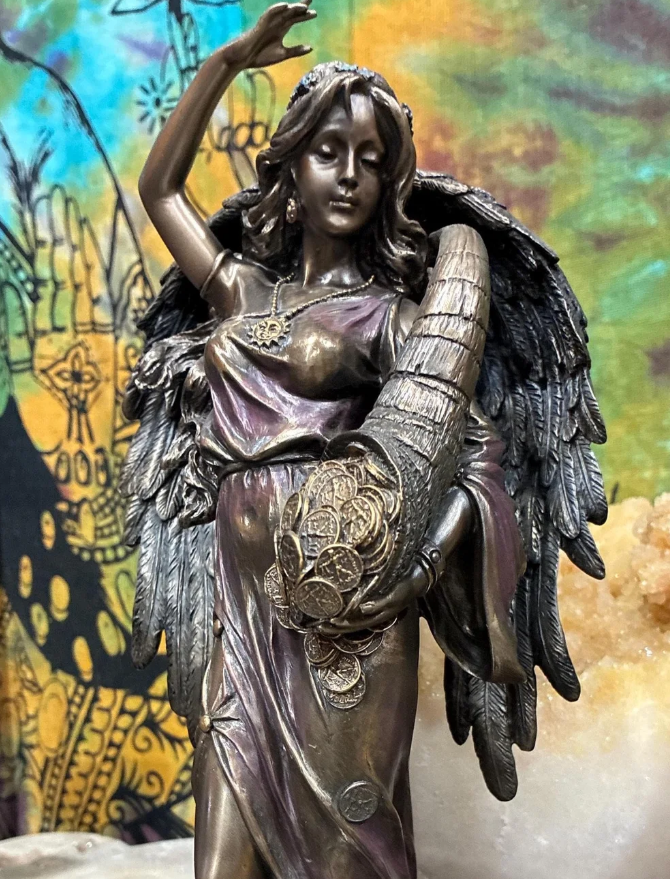
A guide to choosing, placing, and honoring deity statues and altar decor in your spiritual practice
Building an altar is one of the most personal and powerful steps in a spiritual practice. Whether you follow a Wiccan path, work with pagan traditions, or simply feel drawn to the energy of specific deities, your altar becomes the physical anchor for your intentions, rituals, and connection to the divine. At the center of it all — quite literally — sits the deity statue.
In this guide, we'll break down what deities are, why they matter, and how to build an altar around them using statues, candles, crystals, and incense.
What Are Deities?
A deity is a divine being or spiritual force that represents a specific aspect of life, nature, or the cosmos. In metaphysical and pagan traditions, deities are not abstract concepts — they are presences you build a relationship with. You invite them in. You offer to them. You learn from them.
Deities can represent:
Love and compassion — deities like Aphrodite, Hathor, Freyja, Oshun, or Quan Yin
Protection and power — deities like Athena, Medusa, Mars, or the Morrigan
Wisdom and knowledge — deities like Thoth, Odin, Athena, or Saraswati
Abundance and fertility — deities like Cernunnos, Demeter, Lakshmi, Osiris, or Oshun
The moon, magic, and crossroads — deities like Hecate, Diana, or Selene
The underworld and transformation — deities like Anubis, Osiris, Persephone, or Hades
Peace, purity, and creation — deities like Obatala or Brigid
Winter, mountains, and the hunt — deities like Skadi or Artemis
Different traditions approach deities differently. Some practitioners work with one deity exclusively. Others build a pantheon of several. There is no single correct way — what matters is that the connection feels genuine to you.
Deities You Can Work With
At Harry's World, we carry statues of deities from multiple traditions — Norse, Greek, Egyptian, Yoruba, Buddhist, Hinduism and more.. . Here is a reference to help you find the right one for your practice:
Odin — Norse god of wisdom, war, and transformation. Suited for practitioners seeking knowledge, leadership, and the courage to make difficult decisions. He represents sacrifice in pursuit of insight.
Hecate — Greek goddess of the crossroads, magic, and the moon. Ideal for those working with liminal spaces, divination, and night rituals. She guides practitioners through transitions and choices.
Anubis — Egyptian god of the dead, mummification, and guidance through the underworld. Suited for those working with ancestor veneration, grief, and protection during spiritual passage.
Osiris — Egyptian god of the afterlife, resurrection, and fertility. Ideal for practitioners focused on renewal, cycles of death and rebirth, and agricultural or seasonal rituals.
Oshun — Yoruba orisha of love, sweetness, rivers, and abundance. Suited for those seeking emotional healing, attraction, prosperity, and connection to water energy.
Obatala — Yoruba orisha of peace, purity, and creation. Ideal for practitioners focused on clarity, calm, spiritual cleansing, and grounding in stillness.
Skadi — Norse goddess of winter, mountains, and the hunt. Suited for those drawn to independence, endurance, wilderness energy, and solitude as a source of strength.
Medusa — Greek figure of protection, feminine power, and transformation. Ideal for practitioners working with boundary-setting, reclaiming personal power, and warding off negativity.
Athena — Greek goddess of wisdom, strategy, and craftsmanship. Suited for those who value intellect, disciplined planning, and creative skill in their spiritual and daily lives.
Quan Yin — Buddhist bodhisattva of compassion and mercy. Ideal for practitioners focused on loving-kindness, forgiveness, emotional release, and cultivating a gentle, open heart.
These are starting points. Research, meditation, and intuition will tell you which deity is right for your altar. If you feel pulled toward a specific tradition — Norse, Kemetic, Yoruba, Greek, or another path — start there and let the connection develop naturally.
Why Deities Matter in Spiritual Practice
Working with deities gives your practice structure and direction. Instead of approaching your spiritual work as a vague, formless exercise, deity work gives you a focal point — a face, a name, a personality, a set of associations.
Here is what deities bring to a practice:
Focus — A deity gives you something specific to direct your energy toward. Instead of praying to "the universe," you're speaking to someone.
Reciprocity — Spiritual traditions across cultures are built on give-and-take. You make offerings; the deity offers guidance, protection, or blessings in return.
Archetypal energy — Each deity embodies specific qualities. Working with a deity of wisdom helps you cultivate wisdom. A deity of love helps you open your heart.
Continuity — When you work with the same deity over time, the relationship deepens. Your altar becomes a meeting place you return to again and again.
This is why deity statues are so important. They are not decorations — they are the physical representation of a relationship you are building.
The Role of Deities in Building an Altar
An altar is a dedicated space for spiritual work. It can be a shelf, a tabletop, a corner of a room — any surface you set aside for sacred purpose. The question is: how do you structure it?
The deity statue is the natural focal point. Everything else on the altar orbits around it.
A Simple Altar Structure
Here is a basic layout that works for most practitioners:
Center — The deity statue. This is the anchor. Everything faces it.
Front — Offerings and tools. A small bowl for water, a dish for incense ash, ritual tools.
Left side — Candles. Represent fire and illumination.
Right side — Crystals and stones. Represent earth and grounded energy.
Back — Incense burner or sage holder. Represents air and cleansing.
This is a starting point, not a rule. Some traditions have specific directional correspondences (east for air, south for fire, west for water, north for earth). If your path has its own structure, follow that. If you're building intuitively, the layout above works.
Choosing Your Deity Statue
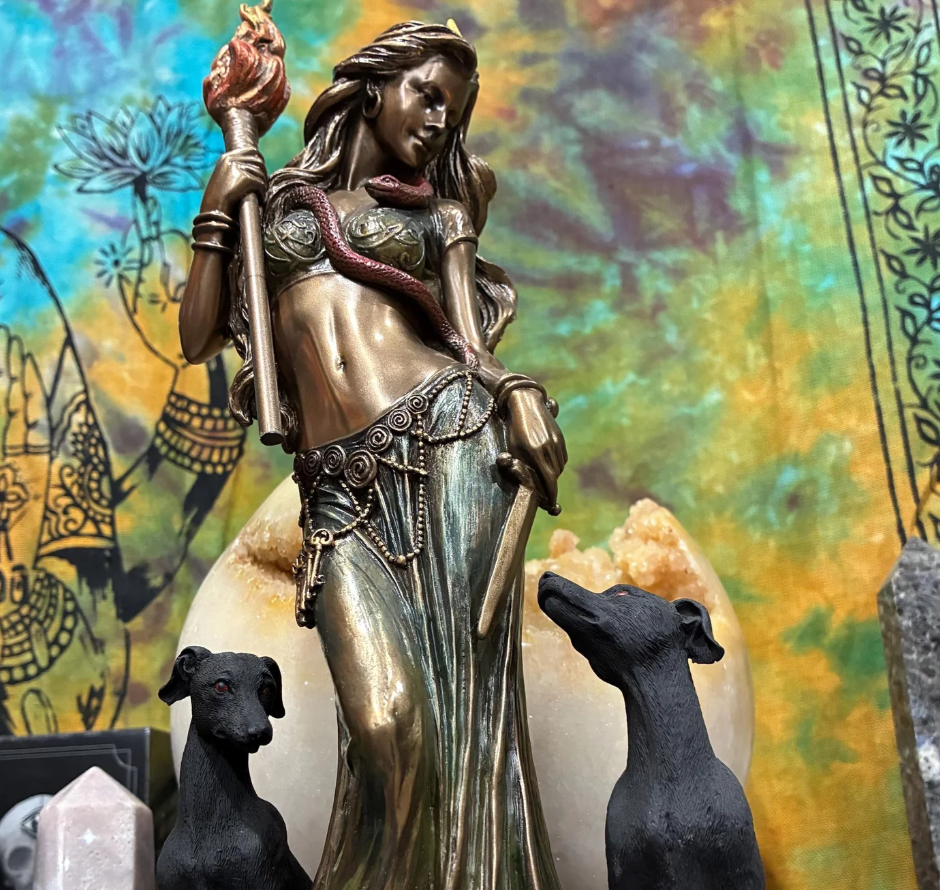
Your deity statue should represent a deity you feel called to work with. Some people know immediately — a goddess appears in a dream, a myth keeps surfacing, a name keeps coming up. Others take time to explore.
When choosing a statue, consider:
Which deity resonates with your current life situation — If you're seeking protection, look at deities associated with guardianship. If you're working on self-love, a love deity makes sense.
The material — Resin, stone, wood, brass. Each carries its own energy. Stone and brass feel grounded and permanent. Resin allows for fine detail.
Size relative to your altar — The statue should be the tallest or most visually prominent item. It is the focal point.
How it makes you feel — This matters more than any rule. If a statue makes you feel something when you look at it, that's the right one.
Altar Decor That Complements Deity Statues
Once your deity statue is placed, the rest of the altar comes alive through complementary decor. Each item serves both a symbolic and a practical purpose.
Candles represent fire, transformation, and illumination. They are one of the most common altar additions across traditions.
White candles — purification, peace, general spiritual work
Black candles — protection, banishing, shadow work
Red candles — love, passion, vitality
Green candles — abundance, growth, healing
Purple candles — spiritual power, intuition, connection to the divine
Place candles to the left of your deity statue or at positions that correspond to your tradition's fire direction.
Crystals bring earth energy to your altar and can be chosen to align with your deity's domain.
Clear quartz — amplifies all energy and intentions; works with any deity
Rose quartz — love, compassion, emotional healing; pairs with love deities
Amethyst — spiritual awareness, intuition, calm; pairs with wisdom and moon deities
Citrine — abundance, manifestation, solar energy; pairs with sun and prosperity deities
Black tourmaline — protection, grounding; pairs with protection deities
Arrange crystals around the base of the statue or on the right side of the altar.
Incense represents air and carries prayers and offerings upward. It also cleanses the space before ritual work.
Frankincense — purification, divine connection; one of the most universal altar incenses
Myrrh — healing, grounding, spiritual protection
Sandalwood — calm, meditation, spiritual openness
Patchouli — grounding, prosperity, earth energy
Lavender — peace, relaxation, dream work
Burn incense at the back of the altar or in a dedicated burner placed near the statue.
Additional Altar Items
Beyond the core decor, consider adding:
A small bowl of water — represents the element of water and can be used for offerings
A bell or chime — used to open and close rituals, clear energy
A cloth or tapestry — defines the altar space visually and energetically
Fresh or dried herbs — mugwort, sage, rosemary, and lavender are common choices
Personal offerings — flowers, honey, bread, or items meaningful to the specific deity
Building Your Altar: A Step-by-Step Summary
Choose your deity — Research, meditate, or simply follow what draws you
Select a statue — Find one that feels right in size, material, and presence
Set your space — Clean the surface physically and energetically (smudge with sage or incense)
Place the statue at center — This is the anchor point
Add candles — For fire, illumination, and intention
Add crystals — For earth energy and amplification
Add incense — For air, cleansing, and carrying offerings
Add personal touches — Offerings, herbs, tools, anything that deepens the connection
Dedicate the altar — Light a candle, speak to the deity, state your intention for the space
Your altar is never finished. It evolves as your practice evolves. Items get added, removed, replaced. What matters is that the space stays active — used, tended, and honored.
Find Deity Statues and Altar Supplies at Harry's World
Building an altar starts with the right pieces. At harry's world, we carry a curated selection of spiritual and metaphysical tools for practitioners at every level.
What you'll find in-store and online:
Crystals including clear quartz, rose quartz, amethyst, and more
Incense and incense burners
Tarot cards, tapestries, and additional altar decor
Visit us:
Address: 1210 South Street, Philadelphia, PA 19147
Hours: Daily 10am-6:30pm | Wednesdays & Weekends 12pm-6:30pm
Phone: 215-309-3326
Online: harrysworldsouthst.com
Returns: 7-day return policy with receipt. Items must be unused and in original condition.
Whether you're setting up your first altar or adding to an existing one, we're here to help you find what you need. Stop by the shop on South Street or browse online.
Harry's World is a metaphysical shop in Philadelphia serving the spiritual, witchy, Wiccan, pagan, herbalist, and shaman communities. Follow us on Instagram @harrys_world_south_street for new arrivals, ritual tips, and shop updates.
#harrysworld #metaphysicalshop #crystalshopphilly #crystalshopsouthstreet #altar #deitystatue #spiritualpractice #wiccan #pagan #altardecor #ritualtools #botanicalshop #herbalshop #occultshop #ritualcandleshop
